The habit of daily writing for you, so that you rethink what you believe about (your) business, brand and marketing —without the bullshit.
Doing it the wrong way
Interview to Jerry Seinfeld - Harvard Business Review
Following yesterday's email about helping your client with what they want, not what they need, this last part needed some closure (or opening).
When you're looking for new ways, different approaches, how to break from what is, to devise, see and design new futures, you'll be wasteful. That's just reality.
You can't make something that'll work out at the first try (well, in most of the cases).
Things will revolve about trial and error —until successful.
That's what innovation is about. Seeing new futures and take chances at what could be built. Embracing failure as a natural part of it.
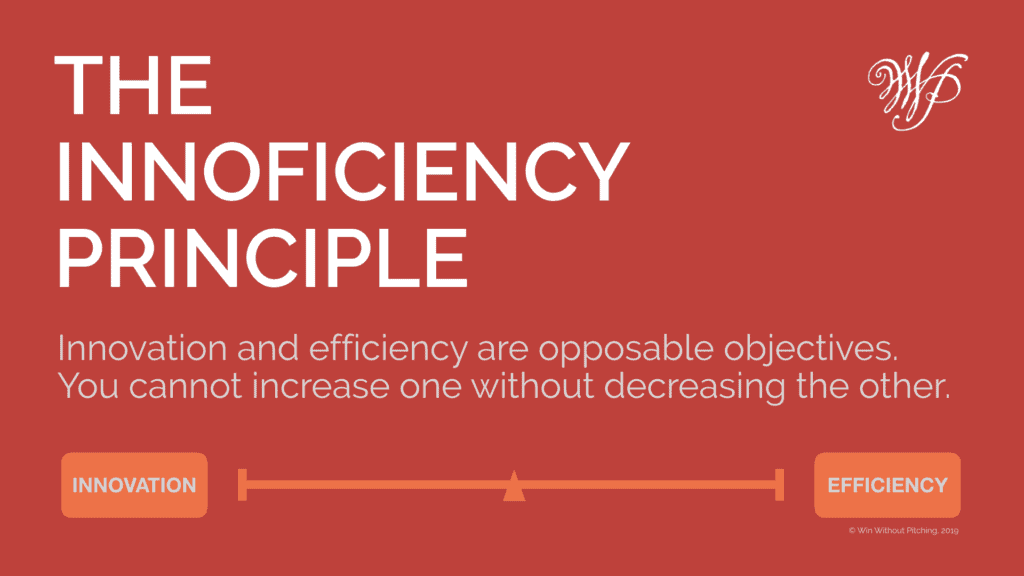
If you focus on how to be innovative while being efficient —you'll be doing it the wrong way.
That's what Blair Enns calls the Innoficiency Principle ↓
 |
Here's the thing
To take charge of the future means focusing on the Innovation side of this balance.
Rod Aparicio
The habit of daily writing for you, so that you rethink what you believe about (your) business, brand and marketing —without the bullshit.
AI will replace you when it can do the things that you do better than you. If you have bad sales calls. It will replace you. If you are general and superficial. It will replace you. If you're average. It will replace you. If your conversations are forgettable. It will replace you. If you aim to serve everyone. It will replace you. Do you know when it can't replace you? When you're specialized and know your craft. It can't think. It can't reason. It can't imagine. It can't decide. It can't be...
Yesterday's message was about how to help your customers for free. When that option is already out of the way, you can help them Offering options. 3 different layers of value, to 3 aligned outcomes. The Transformation: Thinking bigger for them. The Output: Fitting into what they could afford. The Middle-Point: something that you both could co-create.
You're on a mission to help, aren't you? Giving options lets you do that at different levels. The first one you can try is free. For free? Yes and No. To help for free, yes. To work for free, no. If they can't afford you, this is how you can support them. You can help by sharing what you think and how you see things from a general POV. A perspective. It's not specific to their case, yet it's a good starting point to see what they could do by themselves —or how to get help elsewhere with a...